LeakLess: Selective Data Protection Against Memory Leakage Attacks for Serverless Platforms
Abstract
As the use of language-level sandboxing for running untrusted code grows, the risks associated with memory disclosure vulnerabilities and transient execution attacks become increasingly significant. In this paper we present LeakLess, a selective data protection approach for serverless computing platforms. LeakLess alleviates the limitations of previous selective data protection techniques by combining in-memory encryption with a separate I/O module to enable the safe transmission of the protected data between serverless functions and external hosts. We implemented LeakLess on top of the Spin serverless platform and evaluated it with real-world serverless applications. Our results demonstrate that LeakLess offers robust protection while incurring a minor throughput decrease of up to 2.8% when the I/O module runs on a different host than the Spin runtime, and up to 8.5% when it runs on the same host.
The Problem
Serverless FaaS platforms such as Cloudflare Workers and Fastly have moved away from per-tenant process isolation toward language-level sandboxing (WebAssembly) to run multiple customers’ functions within a single process. While this improves density and reduces cold-start latency, it weakens isolation guarantees because bugs in the JavaScript or WebAssembly runtime itself can expose secrets across tenants.
Two classes of attacks exploit this gap:
- Memory disclosure vulnerabilities: out-of-bounds reads in the V8/Wasm runtime can expose the in-memory plaintext of other tenants’ sensitive data.
- Transient execution attacks (Spectre/Meltdown): a malicious co-located function can mount Spectre-BTI or Spectre-BCB attacks to leak secrets from the same address space, even when memory safety guarantees are nominally in place.
Vendor mitigations such as disabling timer APIs or shuffling memory are incomplete. They cannot provide future-proof protection, and process isolation would eliminate all the performance benefits of language-level sandboxing.
Key Insight
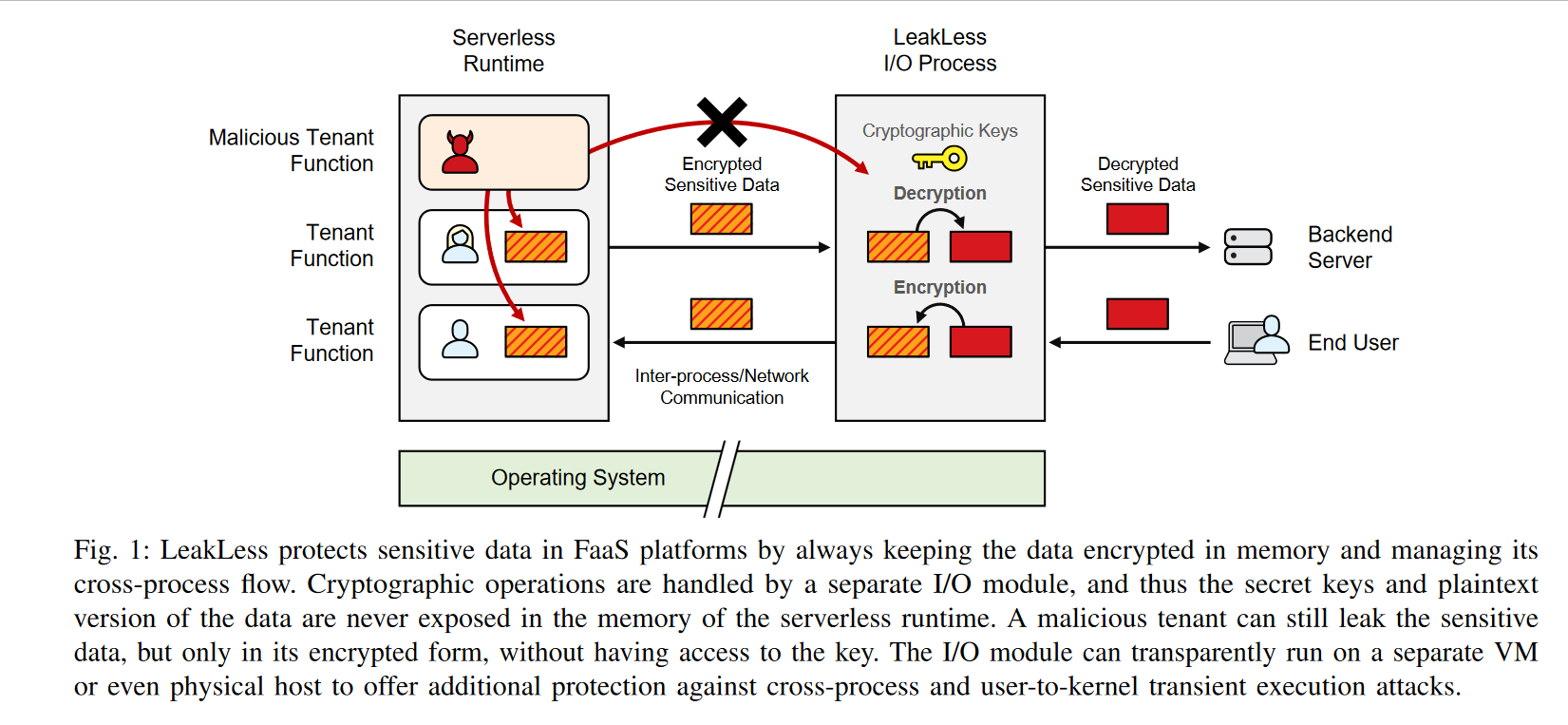
Trying to prevent every possible leakage path is a losing strategy as new Spectre variants continue to emerge. LeakLess takes a different approach: it accepts that data in memory may leak, but ensures leaked data is always encrypted and therefore useless to the attacker.
Any sensitive value that leaves memory through a memory disclosure or a transient execution side channel will be ciphertext. The cryptographic keys never reside in the serverless runtime’s address space.
Design
LeakLess introduces a dedicated I/O module that runs as a separate process (optionally on a separate VM or physical host) and acts as a cryptographic proxy between serverless functions and backend services.
Sensitive data annotation requires minimal developer effort:
- Source code annotation: Developers mark sensitive variables with
#[LEAKLESS_SECRET](Rust) or//#[LEAKLESS_SECRET](Go). The compiler or directive replaces the value with its encrypted form. - Configuration file annotation: Secrets defined in platform configuration files or secrets management APIs are annotated with the
leakless_secretoption, with no code changes required.
Data flow protection:
- Outgoing sensitive data is transmitted with the
LEAKLESS_prefix (encrypted ciphertext). The I/O module intercepts the request, decrypts the value, and forwards the plaintext to the backend. - Incoming sensitive data (e.g., a user’s credit card number) is annotated by client-side JS with the
LEAKLESS_prefix before transmission. When the I/O module receives the request, it identifies values carrying this prefix as sensitive, encrypts them, and preserves theLEAKLESS_prefix on the encrypted value before forwarding the request to the serverless function. Plaintext never enters the runtime’s address space.
This design provides protection against intra-process, cross-process, and user-to-kernel transient execution attacks by varying the deployment topology of the I/O module.
Results
We collected 1,074 publicly available serverless applications from GitHub and assessed their use of sensitive data:
| Metric | Value |
|---|---|
| Apps containing at least one type of sensitive data | 449 / 1,074 (42%) |
| Apps fully supported by LeakLess | 407 / 449 (91%) |
| Apps partially supported | 33 / 449 (7%) |
| Throughput overhead (I/O module on separate host) | up to 2.8% |
| Throughput overhead (I/O module on same host) | up to 8.5% |
Sensitive data types observed across the dataset include authentication secrets, request signing keys, database credentials, and user passwords. LeakLess was experimentally validated with six real-world, widely-used serverless applications under stress-testing conditions.
Venue
Network and Distributed System Security (NDSS) Symposium 2025 February 24-28, 2025 · San Diego, CA, USA ISBN 979-8-9894372-8-3 · DOI: 10.14722/ndss.2025.230035